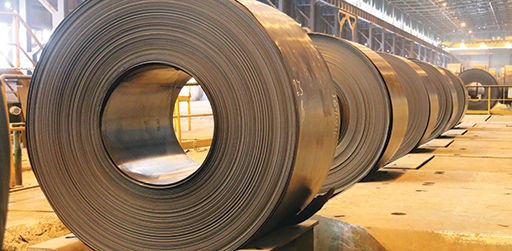
Signs or shortcodes are marked on the products in continuous casting to identify and track the slabs produced. For the project at Mobarakeh Steel Company, a method involving spraying metal and ceramic powders to mark these products based on the production slab conditions was presented.
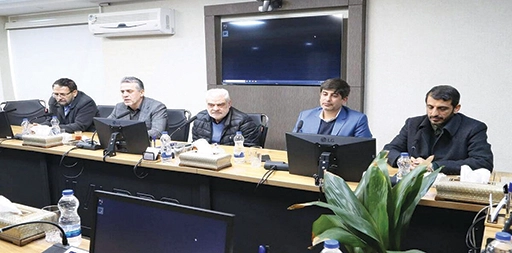
A contract was signed between the “Research and Development Department of Mobarakeh Steel Company” and the “Mobarakeh Steel Venture Capital and Technology Fund” to implement this project on the fourth casting line.
Initially, this contract was meant for the installation of casting on line 4 with two robots, but one of these robots was later moved to line 5. Due to sanctions and the subsequent lack of cooperation from various companies to supply equipment and offer related technical knowledge to the contractor, the decision was made to go with two ABB Foundry robots capable of operating effectively in challenging environments.
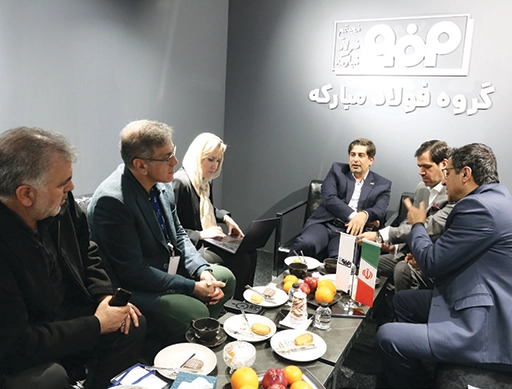
Based on the negotiations, Mr. Dr. Arnett, one of the directors of Ron Mas Company, has been assigned to consult the technical knowledge department on various issues related to the project, such as powder spraying on the slab. The agreed amount for his technical knowledge and cooperation within Iran is approximately two hundred and fifty thousand euros.
The implementing company shifted from being “product-oriented” to focusing on technology development. This change aimed to localize technical knowledge. As a result, Iranian experts successfully acquired technical knowledge in all project-related areas and effectively carried out the entire project.
During this process, the robot reaches the correct position at the front edge of the slab to prepare the surface for powder spraying and cooling. It descales the surface by using a high-pressure water jet. Then, the powder spraying device sprays the desired powder onto the slab surface at 100 mm/s, following the designated path based on the required markings.
During the project’s execution stages, acquiring technical knowledge of the marking process is crucial. This involves investigating the various parameters that affect the process and conducting manual tests in the operational environment. The goal is to demonstrate the existence of technical knowledge and the skills needed to carry out the process effectively.
In the following stages, we designed the peripheral equipment needed for the robot, programmed the robot’s activities, and conducted operational tests in the presence of the managers of the Mobarakeh steel casting unit.
Subsequently, we designed the necessary space for installing the robot and prepared the location in Unit No. 5 of Mobarakeh Steel Foundry. The robot has since been moved to the designated and constructed enclosure and is currently in the final stages of installation and preparation for functional tests and delivery.
The implementation of this project has enabled Iranian companies to acquire technical knowledge about robot work in high-temperature environments. This includes designing robot thermal shields, deoxidation equipment using high-pressure water jets, and spraying powder on slabs with the requisite strength and stability. This technical knowledge will widely be used in the implementation of other projects, including the installation of a slag-catching robot, a sampling and measuring robot, and a position detection robot.

tional scale and, finally, its commercialization, some CO2 remains. This brings us closer to the goal of carbon neutrality by applying CCUS (Carbon Capture, Utilization, and Storage) methods. This method converts CO2 into products with high added value, such as green methanol, green ethanol, acetic acid, methane, etc., and can be reused.
A green supply chain is essential to achieving green processes and technologies. This includes producing green hydrogen, utilizing renewable energy, adopting sustainable transportation with low carbon emissions, and more. Mobarakeh Steel Company has laid out a plan and strategic measures for this and is currently in the implementation phase.
In addition to having a green supply chain and using green processes and technologies, producing sustainable and environmentally friendly products is one of the most important strategies for achieving carbon neutrality in the steel life cycle. Mobarakeh Steel Company seeks to produce special products with greater durability, high strength, and lightweight properties. This production not only reduces environmental impact and carbon footprint but also consumes fewer resources in their life cycle, bringing the organization closer to the goal of carbon neutrality.
In line with these goals, measures have been initiated since 2023. To enhance our environmental sustainability efforts, we will:
– Establish a carbon working group to measure greenhouse gas emissions and product carbon footprint according to the international standards ISO14064-1:2018 and ISO 14067:2018.
– Form circular economy working groups to implement international models and standards.
– Make significant investments in producing economical and renewable electricity.
– Provide necessary training to promote the culture of green steel production (low carbon emission) and circular economy.
– Optimize material use by maximizing the use of scraps and improving material efficiency.
– Invest in transportation to utilize railway lines and reduce carbon emissions.
– Develop green spaces strategically to earn carbon credits.