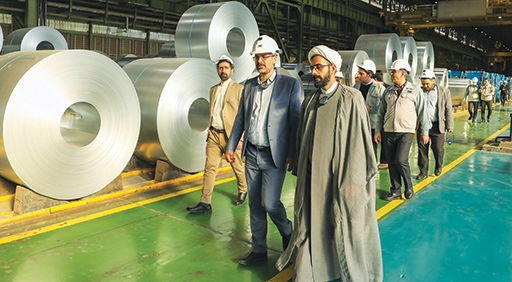
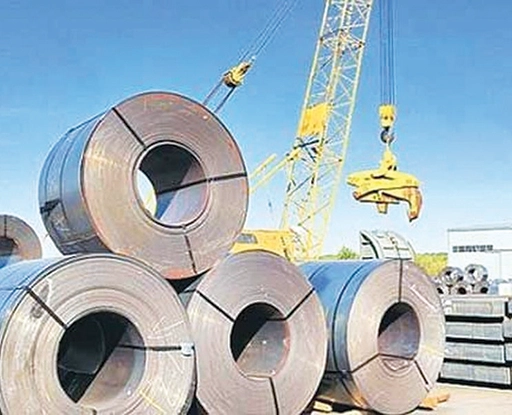
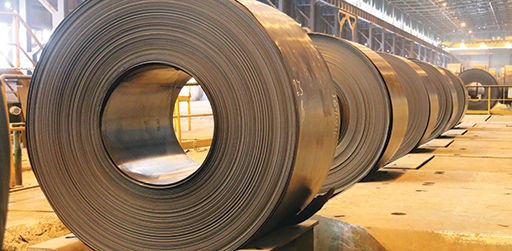
The critical project to transfer water from the Persian Gulf and the Sea of Oman to Iran›s central plateau is currently in progress. It does not rely on the import of any essential steel grades, but instead depends on steel sheets produced by Mobarakeh Steel.
At present, over 900,000 tons of steel pipes have been produced using Mobarakeh steel slabs and have been delivered for water transfer projects. The remaining pipes are still in production and are being made as per the project requirements. Kowsar Pipe Company, a subsidiary of Mobarakeh Steel Company under the Atiyeh Steel Group, is also playing a significant role in the water pipe construction.
The project to transfer water from the Persian Gulf and the Sea of Oman to the central plateau of Iran, in order to meet the region›s water needs, has been under serious consideration since 2013. With the establishment of the Persian Gulf Water Supply Company (WASCO), the project has now entered its final study phase and plans are underway for its implementation.
In order to supply water to the provinces of Hormozgan, Fars, Bushehr, Kerman, Yazd, Sistan and Baluchistan, Isfahan and Khorasan from the Persian Gulf, five water transmission lines were examined and finally approved. The main purpose of establishing these lines in the first stage has been to supply water to industries in the mentioned provinces. This is intended to help the survival and development of industries, while also supporting domestic and agricultural consumption by freeing up fresh water for these uses.
Preliminary calculations for the implementation of lines 1, 3, and 4 have estimated the consumption of at least 2.3 million tons of steel sheets with ST52 and X65 grades. Based on the operation of line 1 and the implementation schedule of water supply lines 3 and 4, upon completion of the projects, the supply of steel sheets required for the production of spiral steel pipes can also be supported. By March 2025, it will be possible to supply about 70 million cubic meters of water to Isfahan.

Below is a concise description of each transmission line project.
The consortium of Wasco Company, consisting of three mining and industrial companies (Golgohar, National Copper Industries of Iran, and Chadormalu Mining and Industrial Company), began producing pipes and implementing line 1 in 2016. In 2019, they completed a 826 km route from the Bandar Abbas desalination plant to Ardakan, operating the Yazd water transfer system with a capacity of 130 million cubic meters. Line 1 and 2 from Hormozgan province to Kerman and Yazd provinces:
Line 1: More than 350,000 tons of steel sheets from Mobarakeh Steel Company products have been used to produce 1600 mm diameter steel pipes. These pipes have undergone rigorous quality checks and received external and internal coatings before being put to technical use

Before commencing the process, we finished several preparatory activities. In addition, we carried out various offline tasks and made adjustments to the production line, sometimes extending shutdown times to conduct revamp work, which helped us minimize stoppage time.
Looking ahead
MSC’s perspective on the future is an important issue. Last year, MSC took a bold step towards green steel production. Mobarakeh Steel is the first company in the country to focus on this issue and put it into practice. This is a new approach globally, and we have worked and invested in this area alongside world’s major steel-making companies.
The requirements include the provision of water, electricity, and relevant knowledge. In our country, significant progress has been made in the discussion of electricity, particularly in the field of combined cycle power plants and solar power plants. The scientific discussion is not overly complicated and can

be easily undertaken by the company.
Last year, we started the construction of aa solar power plant in the eastern region of Isfahan. This year we are planning to start operating the first phase of this project, generating 40 megawatts of electricity initially and eventually increasing this to 140 megawatts. Additionally, we are exploring projects associated with wind power plants in the eastern part of the country.
This process is crucial for MSC. Over the past two years, Mobarakeh Steel has been proactive rather than waiting for supports.
When a major industry takes off, it can no longer rely on a specific organization, institution, or even the government to provide the necessary infrastructure. Over the past two years, Mobarakeh Steel Company has taken effective measures in electricity, rail, and locomotives. We also have plans in place for natural gas-related infrastructure. The key to this approach lies in the management and strategy that the company has developed for itself. From this perspective, 2023 has been a successful year for Mobarakeh Steel Company.